
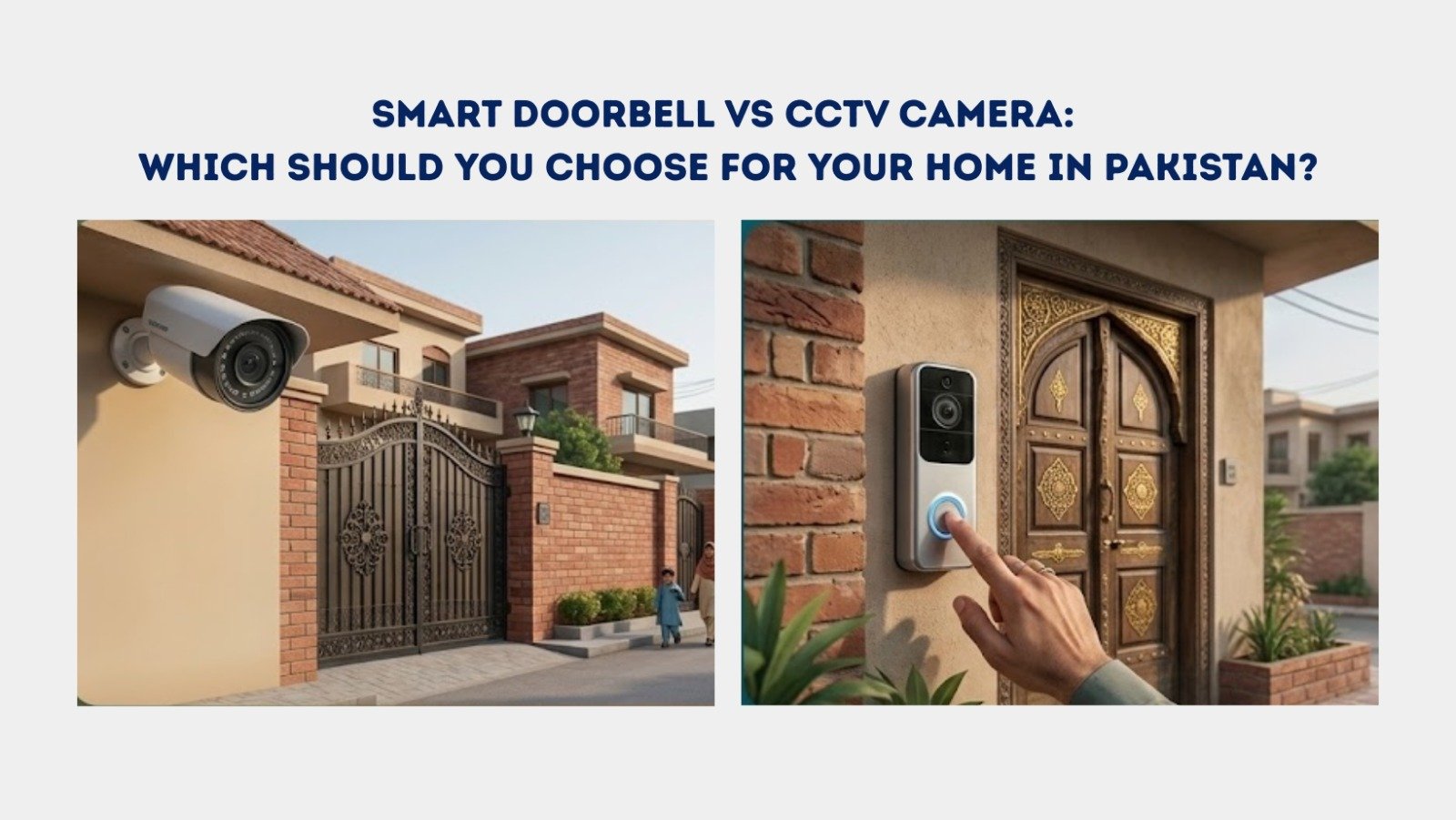
Home security in Pakistan used to mean a heavy iron gate, a tall boundary wall, and a calling bell you could barely hear from the back of the house. That’s changed. Most people now want to know what’s happening at their door while they’re at the office, stuck in traffic, or traveling.
When upgrading, two options come up again and again: a Smart Doorbell vs CCTV Camera system. They both record video, so it’s easy to assume they’re interchangeable. They’re not. They’re built for different jobs, and picking the wrong one for your home means either paying for coverage you don’t need or missing coverage you do.
This Smart Doorbell vs CCTV Camera guide breaks down what each does, where each wins, and when it makes sense to use both.
What Each One Actually Is
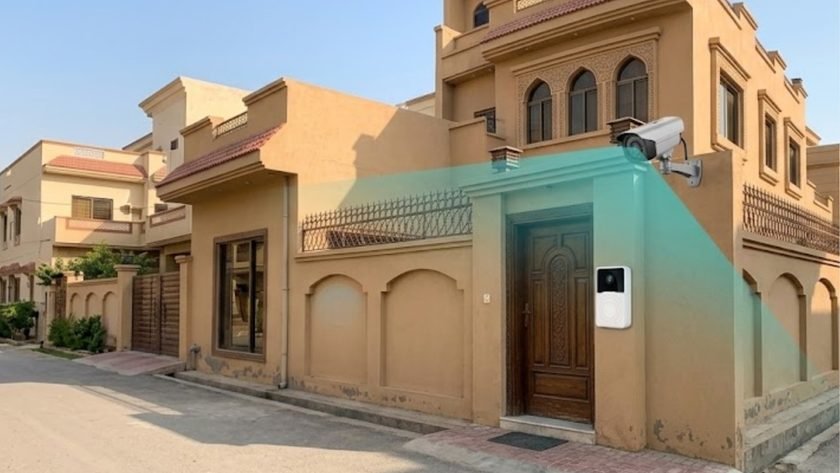
A smart doorbell camera replaces your regular push-button bell. It packs an HD camera, a microphone, a speaker, and a motion sensor into one wall-mounted unit. When someone presses the button, or the sensor catches movement on your porch, your phone gets an instant alert — and you can see, hear, and talk to whoever’s there from anywhere. eGalaxy’s Wireless Video Doorbell with Camera is a good example of the category.
A CCTV camera system is dedicated surveillance for wider areas: gates, driveways, boundary walls, backyards. Traditional setups run several cameras into a DVR or NVR recorder, while newer standalone Wi-Fi cameras save footage to an SD card or the cloud instead.
Smart Doorbell vs CCTV Camera: The Real Differences
| Feature | Smart Doorbell Camera | CCTV Camera System |
|---|---|---|
| Primary job | Greeting and screening visitors at the door | Wide-area, ongoing surveillance |
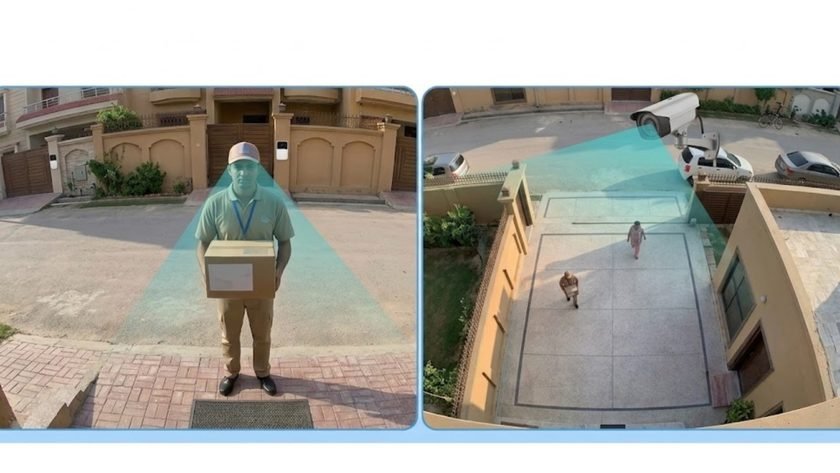
| Field of view | Head-to-toe vertical view for porches and parcels | Wide, panoramic, or pan-tilt-zoom (PTZ) coverage |
| Communication | Built-in two-way audio | Mostly one-way recording (some newer models add audio) |
| Recording | Motion- or button-triggered clips | Continuous 24/7 or motion-based |
| Installation | Simple DIY, battery or existing doorbell wiring | Often needs cabling, drilling, and recorder setup |
Coverage: Narrow and Close vs Wide and High
A doorbell sits at eye level beside your door and sees a tall, narrow slice — a visitor’s face, a courier, a parcel on the floor. That’s exactly what you want for the front entrance, and it’s a view a high-mounted camera doesn’t give you.
CCTV cameras are typically mounted 2.5 to 3 meters up on exterior walls or eaves, and they watch over big open spaces — a long driveway, a lawn, a storefront. PTZ models can pan to remove blind spots entirely.
Interaction: A Conversation vs a Recording
This is the difference most people feel day to day. A doorbell is interactive. If a courier arrives while you’re at work, your phone rings, you answer through the app, and you tell the rider exactly where to leave the parcel. It works a bit like having someone stationed at the gate.
A CCTV system is passive. You can watch a live feed, but there’s no conversation with whoever’s standing outside. What you get instead is a thorough record of everything that happens, a strong visual deterrent, and footage that can serve as evidence if something goes wrong.
For a closer look at doorbell features in particular, our smart doorbell camera buying guide covers resolution, night vision, and viewing angle in detail.
Built for Pakistani Conditions: Load-Shedding and Weather
Any security hardware here has to cope with summer heat, monsoon rain, dust, and power cuts.
Weather. Quality models of both types carry weatherproof ratings such as IP65 or IP66 (the IP code tells you how well a device resists dust and water). Even so, a doorbell exposed to heavy downpours should be mounted under a porch shade or overhang.
Power cuts. Many wireless doorbells run on a built-in rechargeable battery, so the device itself keeps working through load-shedding. One caveat: it still needs Wi-Fi to send you alerts, and your router may be off too unless it’s on a UPS or backup. A multi-camera CCTV kit with a recorder needs UPS or similar backup if you want recording to continue without a gap.
Which One Should You Choose?
Go with a smart doorbell camera if…
- You live in an apartment or terrace house. If your door opens onto a shared hallway or a small porch, a doorbell gives you control over who approaches your private threshold.
- You get a lot of online deliveries. With e-commerce so common now, a video doorbell means you never miss a courier, and you can give instructions remotely.
- You want an easy DIY install. Most can be mounted in minutes, with no professional wiring.
Go with a CCTV system if…
- You own a large bungalow, farmhouse, or commercial property. Multiple entry points, long boundary walls, and big driveways need multi-angle coverage.
- You need continuous recording. For weeks of round-the-clock footage, a hard-drive-backed system is hard to beat.
- You want a visible deterrent. A set of cameras on exterior walls puts off a lot of would-be burglars before they even try.
The Best Answer for Most Homes: Use Both
It doesn’t have to be one or the other. A lot of Pakistani homeowners run a hybrid setup:
- A smart doorbell at the main entrance, to screen visitors, handle deliveries, and talk through two-way audio.
- Cameras along the perimeter, back alley, and garage, for steady 24/7 watch over the vulnerable edges of the property.
For inside the house, an Indoor Security Camera fills the remaining gap. Add Door & Window Sensors and Motion Sensors, and everything runs from one Tuya Smart app. If you’re weighing the doorbell on its own merits, see why every Pakistani home benefits from a smart doorbell camera. eGalaxy’s Home Automation range covers the wider ecosystem.